Class X vs Class Y Capacitors: What’s the Difference?
2026-04-25
234
Catalog
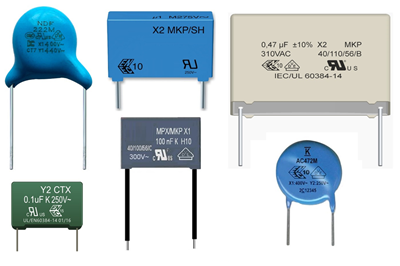
Figure 1. Class X and Y Safety Capacitors
What Are Class X and Class Y Capacitors?
Class X and Class Y capacitors are safety-rated capacitors used in AC power circuits, especially in devices connected directly to the mains supply. Their main purpose is to reduce electrical noise and keep circuits working properly while maintaining safety. As they are connected to high voltage and can experience power surges, they are made with special designs that meet strict safety standards.
These are called safety capacitors since they are built to fail in a safe and controlled way. This helps prevent risks such as electric shock, short circuits, or fire. Class X capacitors are usually connected between the power lines, while Class Y capacitors are connected between the line and ground, where safety is more needed.
How Class X and Class Y Capacitors Work
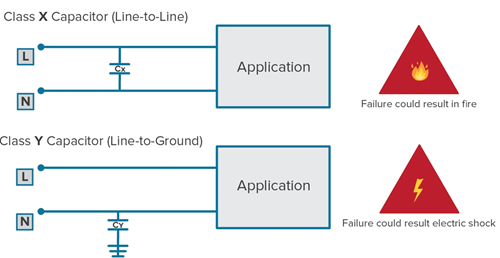
Figure 2. Class X vs Class Y Capacitor Connection Diagram
Class X and Class Y capacitors work by filtering high-frequency noise that travels along AC power lines. Electrical systems often generate unwanted signals such as electromagnetic interference (EMI), which can affect the performance of electronic devices. These capacitors help reduce that interference.
Class X capacitors are placed across the power lines, where they absorb and smooth out noise between the conductors. Class Y capacitors are connected between the line and ground, where they safely direct unwanted signals away from the circuit. By controlling these noise signals, both types help improve signal stability and reduce interference in electronic systems.
Class X vs Class Y Capacitors: What’s the Difference?
Class X and Class Y capacitors are both used to reduce electrical noise in AC power circuits, but they differ in where they are connected and their safety role. Class X capacitors are placed between the live and neutral lines to filter noise across the power supply and have lower safety risk. Class Y capacitors are connected between the line and ground, where safety is more needed as failure could lead to electric shock. For this reason, Class Y capacitors are designed to fail open, while Class X capacitors may fail short and rely on protection devices like fuses. The differences are summarized in the table below:
|
Feature |
Class
X Capacitor |
Class
Y Capacitor |
|
Connection |
Line to Line
(Live–Neutral) |
Line to Ground |
|
Main Purpose |
Reduce noise across
the power line |
Reduce noise to
ground and improve safety |
|
Safety Risk |
Lower risk |
Higher risk (directly
related to user safety) |
|
Failure Mode |
May fail short |
Designed to fail open |
|
Protection |
Triggers fuse or
breaker if shorted |
Prevents electric
shock by opening |
|
Common Use |
Across-the-line
filtering |
Line-to-ground
filtering |
|
Safety Requirement |
Standard safety
design |
Stricter safety
design |
|
Applications |
Power supplies,
appliances |
EMI filters,
grounding circuits |
Class X and Class Y Capacitor Ratings
Safety capacitors are classified based on their ability to handle voltage and surge conditions in AC circuits. These ratings follow international standards and help ensure safe operation when connected to the mains supply.
Class X Ratings
|
Subclass |
Surge
Capability (Peak Pulse) |
Impulse
Withstand (Typical) |
Use
Case |
|
X1 |
High (>2.5 kV) |
Up to ~4 kV |
High surge
environments |
|
X2 |
Medium (≤2.5 kV) |
Up to ~2.5 kV |
General appliances
(most common) |
|
X3 |
Low (≤1.2 kV) |
Not specified |
Low surge conditions |
Class Y Ratings
|
Subclass |
Rated
Voltage |
Impulse
Withstand (Typical) |
Use
Case |
|
Y1 |
Up to ~500 VAC |
Up to ~8 kV |
High safety
applications |
|
Y2 |
~150–300 VAC |
Up to ~5 kV |
General-purpose use
(common) |
|
Y3 |
~150–250 VAC |
Not specified |
Limited use |
|
Y4 |
Below ~150 VAC |
Up to ~2.5 kV |
Low-voltage
applications |
Types of Class X Capacitors
Class X capacitors are selected based on how much electrical stress a circuit may face. Instead of focusing only on technical values, it is more helpful to understand where each type performs best in actual situations and how it fits into the overall design.
• X1 → suited for harsh environments where strong voltage spikes or unstable power conditions may occur, such as industrial equipment or areas with frequent surges. This type is chosen when long-term reliability and protection against high-energy events are required.
• X2 → the most widely used option in home appliances, adapters, and power supplies. It works well under normal operating conditions and provides effective noise filtering for everyday electronics without the need for extreme surge protection.
• X3 → intended for low-stress circuits, where voltage disturbances are minimal and the electrical environment is stable. It is less common and typically used in controlled conditions where high surge protection is not required.
Types of Class Y Capacitors
Class Y capacitors are selected based on the level of safety required, since they are connected between the power line and ground. Since this position is required, each type is designed to provide a different level of protection depending on the application and operating conditions.
• Y1 → designed for high-risk environments, such as industrial systems or medical equipment, where maximum protection is required. This type handles higher voltage stress and is used in circuits with strict safety requirements.
• Y2 → the most common choice for household appliances and consumer electronics. It provides reliable protection while maintaining good performance under normal conditions.
• Y3 → used in specialized or less common designs, often where specific design constraints apply. It is not widely used in modern applications.
• Y4 → suited for low-voltage systems, where electrical stress is lower and the required safety level is not as demanding.
Applications of Class X and Class Y Capacitors
Power Supplies - applied in input filtering stages to reduce noise and stabilize the power entering the circuit.
Home Appliances - found in devices like TVs, washing machines, and refrigerators to minimize interference and ensure reliable operation.
EMI/RFI Filters - used to suppress electromagnetic and radio-frequency noise, helping devices meet regulatory standards.
Audio Equipment - helps remove unwanted noise, improving sound clarity in amplifiers and speakers.
Communication Systems - reduces interference that can affect signal transmission and performance.
Industrial Equipment - used in machines exposed to high electrical noise to maintain stable operation.
Medical Devices - ensures safe operation and reduces interference in sensitive electronic systems.
Consumer Electronics - used in chargers, adapters, and small electronic devices for noise control and protection.
How to Choose the Right Safety Capacitor
Identify the connection point - Use a Class X capacitor for line-to-line filtering and a Class Y capacitor for line-to-ground protection.
Check the voltage rating - Make sure the capacitor can handle the AC voltage and possible surges in your system.
Select the correct class (X1, X2, Y1, Y2) - Choose a higher class for circuits exposed to strong voltage spikes or essential safety conditions.
Consider the application environment - Industrial systems may require higher-rated components, while household devices usually use standard types.
Look for safety certifications - Ensure the capacitor meets recognized standards such as IEC, UL, or CSA for reliable operation.
Check physical size and mounting - Make sure the component fits your circuit design and layout.
Balance cost and performance - Choose a capacitor that meets safety needs without overdesigning the circuit.
Safety Standards for Class X and Y Capacitors
Class X and Class Y capacitors must follow strict safety standards as they are connected directly to AC mains and exposed to high voltage and surges. These standards ensure that the capacitors operate reliably and fail in a way that does not create hazards such as electric shock or fire.
These components are tested and certified by recognized organizations such as IEC (International Electrotechnical Commission), UL (Underwriters Laboratories), and CSA (Canadian Standards Association). The most widely used guideline is IEC 60384-14, which defines the classification, testing methods, and performance requirements for safety capacitors.
To meet these standards, capacitors undergo tests such as:
• High-voltage testing to ensure they can handle normal and surge conditions
• Impulse testing to verify resistance to sudden voltage spikes
• Endurance testing to check long-term reliability
• Failure testing to confirm they fail safely (open or controlled behavior)
Common Mistakes When Using Safety Capacitors
When using safety capacitors, several mistakes can affect both performance and safety. One of the biggest issues is using the wrong type (Class X vs Class Y), especially placing a Class X capacitor in a line-to-ground position, which can increase shock risk. Another problem is choosing the wrong rating, where a lower class may not handle voltage surges properly and can fail early. It is also required to avoid ignoring safety certifications, as non-certified components may not meet required standards. You can overlook actual operating conditions, such as voltage spikes or unstable power, which can damage the capacitor. In addition, poor circuit placement and improper grounding can reduce filtering effectiveness and create safety concerns. Using low-quality or damaged components can lead to unreliable operation, and assuming that all capacitors are the same is a serious mistake, only safety-rated capacitors should be used in AC mains applications.
Conclusion
Class X and Class Y capacitors help keep electronic circuits working properly and safely. By understanding their purpose, types, and correct use, you can choose the right capacitor for your needs and avoid problems. Using the right safety capacitor and following proper guidelines will help protect both the device and you, while improving overall performance.
 ABOUT US
Customer satisfaction every time. Mutual trust and common interests.
ABOUT US
Customer satisfaction every time. Mutual trust and common interests.
function test. The highest cost-effective products and the best service is our eternal commitment.
Hot Article
- LM358 Dual Operational Amplifier Comprehensive Guide: Pinouts, Circuit Diagrams, Equivalents, Useful Examples
- Are CR2032 and CR2016 Interchangeable?
- Understanding the Differences ESP32 and ESP32-S3 Technical and Performance Analysis
- Choosing the Right Battery: A Guide to AG4, LR626, LR66, 177/376/377, SR626, and SR626SW Equivalents
- NPN vs. PNP: What's the Difference?
- BC547 Transistor Basics: Pinout, Application Circuits, Alternative/Complementary Models
- esp32 vs stm32: which microcontroller is better for you?
- What Is a MOSFET and How It Works?
- Electrical Relay Basic: Working Operation, Types and Uses
- PNP Transistors: Structure, Working Principle and Application
 What Is the Difference Between a MOSFET and a Relay?
2026-04-26
 Ceramic vs Electrolytic Capacitors: Choosing the Right One for Your Circuit
2026-04-24
Frequently Asked Questions [FAQ]
1. Can I replace a Class X capacitor with a normal capacitor?
No, you should not replace a Class X capacitor with a regular capacitor. Safety capacitors are specially designed to handle high voltage and surge conditions from AC mains. A standard capacitor may fail under these conditions and could lead to damage, fire, or safety hazards.
2. What happens if a safety capacitor fails?
The behavior depends on the type. Class X capacitors may fail in a way that triggers a fuse or circuit breaker, stopping the circuit. Class Y capacitors are designed to fail open, meaning they stop working but do not create a dangerous shock risk.
3. Why are safety capacitors used in power supplies?
They are used to reduce noise coming from the AC line and to prevent interference from affecting the circuit. This helps improve stability, protect sensitive components, and ensure the device works properly under different conditions.
4. Do safety capacitors affect power consumption?
No, their effect on power consumption is very small. They mainly filter unwanted signals and do not change how much power the device uses during normal operation.
5. Can I use a higher-rated safety capacitor than required?
Yes, using a higher-rated capacitor is generally safe and can provide extra protection against surges. However, it may increase cost and size, so it is best to choose a rating that matches your design needs.
6. Are safety capacitors polarized?
No, safety capacitors are non-polarized. This means they can be connected in either direction in the circuit without affecting their function.
7. How do I identify a safety capacitor?
Safety capacitors are labeled with markings such as X1, X2, Y1, or Y2. They also include certification marks like UL, IEC, or CSA, which show that they meet safety standards.
Hot Part Number
 C0402X6S0G331K020BC
 GRT31CR61E475KE01L
 GR442QR73D221KW01L
 GRM0335C1E2R7CA01J
- GRM033R71E332KA12J
 EMK063B7682KP-F
 CS1206KKX7RYBB473
 LD02YC181KAB2A
 12105C154KHT1A
 1812GA221JAT9A
- T495X336M025AHE200
- DSI30-12A
- SI6975DQ-T1-E3
- SL38160AZC-18AHT
- MAX3232EEUE+T
- MT48LC4M16A2P-6:G
- MAX6356TWUT+T
- LCMXO1200C-5FTN256C
- FP15R12KT3
- LTC3638IMSE#PBF
- T491A474M025AT7622
- TMS320C6455BCTZ7
- T491D106K035AH2478
- T491X226M035ATAUTO
- T491C475M035ZTAU00
- ST7FLITE02Y0M6
- LT4256-1IS8#PBF
- LM2594MX-5.0/NOPB
- GE212JIYJ23JB
- GE28F256L18B
- HD64F2329BVTE25
- ICS93722CF
- IS61LPS51236A-200TQL
- KSZ8841PMQL
- MT41K256M16TW-107IT:P
- MT49H16M18CFM-5IT
- P51XAG37KBBD
- ST19NP18ER28PVMX
- STPR1020CTW
- AK4311AVM-E2
- LR36A11A
- NAT7210BPD
- IH5047MJE/883B
- MAX232MJE/883
- MM3Z2V4S
- GS8662Q18BGD-300
- AD8876ACPZ
- WL2851E33-5/TR
- BM05B-PASS-TF