4-Variable K-Map Logic Simplification Using Gray Code
2026-05-27
430
Catalog
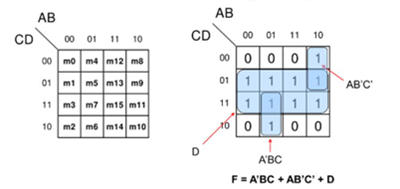
Figure 1. 4-Variable K-Map Simplification Example
4-Variable Karnaugh Map Basics
A 4-variable Karnaugh map (K-map) is a visual tool that helps you simplify Boolean expressions and digital logic circuits with four input variables. Instead of solving long Boolean algebra equations manually, you can use the K-map to organize logic values in a simple 4×4 grid. As the four variables have 16 possible input combinations, the map contains 16 cells.
2⁴ = 16
When you use a 4-variable K-map, you can quickly spot patterns and group adjacent cells together to simplify the logic expression. This makes the final circuit easier to build since it reduces the number of logic gates and unnecessary variables.
You will commonly use 4-variable K-maps when designing digital circuits, troubleshooting logic systems, studying Boolean algebra, or creating combinational logic projects. The biggest advantage is that it lets you simplify logic visually, which is usually faster and easier than solving complex equations by hand.
Gray Code in 4-Variable K-Maps
In a 4-variable K-map, you arrange the rows and columns using Gray code, not normal binary order. This means the labels usually follow this order:
00, 01, 11, 10
This order is required as each neighboring row or column changes by only one variable. For example, from 01 to 11, only the first bit changes. From 11 to 10, only the second bit changes.
This helps you read the K-map correctly because neighboring cells must be logically related. When only one variable changes between adjacent cells, the map can support valid Boolean simplification.
So, when you look at a 4-variable K-map, remember that the unusual order is intentional. It is designed to keep nearby cells different by only one variable, which makes the K-map suitable and accurate in digital logic.
Truth Table to 4-Variable K-Map
When you transfer values from a truth table to a 4-variable K-map, you place each output value into the cell that matches its input combination. Every row in the truth table corresponds to one unique cell in the K-map.
For a 4-variable system, the variables are commonly divided into two groups:
• AB for the rows
• CD for the columns
Here is a small example:
|
A |
B |
C |
D |
Output |
|
0 |
0 |
0 |
0 |
1 |
|
0 |
0 |
0 |
1 |
0 |
|
0 |
0 |
1 |
0 |
1 |
|
0 |
0 |
1 |
1 |
1 |
A = 0, B = 0, C = 1, D = 0
matches:
• Row → AB = 00
• Column → CD = 10
The output value for that combination is then written into that cell of the K-map.
This process continues until all truth table outputs are transferred into their corresponding K-map positions. At this stage, your goal is simply to place the values correctly so the map accurately represents the logic function.
Grouping Rules in 4-Variable K-Maps
When you group cells in a 4-variable K-map, your goal is to connect cells with the same value. For SOP simplification, you usually group 1s. For POS simplification, you usually group 0s.
A valid group must contain 1, 2, 4, 8, or 16 cells. You should not make groups with 3, 5, 6, or 7 cells since K-map groups must follow powers of two. The cells must also be adjacent horizontally or vertically, not diagonally.
You should always try to make the largest possible group first. A larger group usually gives a simpler result later. For example, one group of 4 is better than two separate groups of 2 if the larger group is valid.
Overlapping is also allowed. You can reuse a cell in more than one group if it helps you create a larger or cleaner grouping pattern. Also remember that the K-map edges wrap around, so cells on the left and right edges can be adjacent, and cells on the top and bottom edges can also be adjacent.
Boolean Simplification Using 4-Variable K-Maps
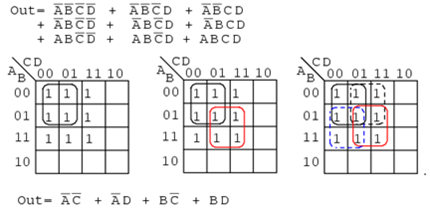
Figure 2. Solved 4-Variable K-Map Example
After you finish grouping the cells in a 4-variable K-map, the next step is to convert each group into a simplified Boolean term. You do this by checking which variables stay the same inside the group and which variables change.
If a variable has the same value across all cells in the group, you keep it in the simplified term. If the variable changes from 0 to 1 or 1 to 0 within the group, you remove it. This is the main reason K-maps make Boolean simplification easier: changing variables cancel out, while unchanged variables remain.
For example, if all cells in one group have A = 1 and B = 1, but C and D change, the simplified term becomes AB. This means only A and B are needed to describe that group.
When you have more than one group, you convert each group into its own Boolean term. Then, those terms are combined to form the simplified Boolean expression. At this stage, your focus is no longer just on drawing groups, but on reading each group correctly and identifying the variables that do not change.
This step is required since one wrong variable reading can change the final Boolean expression, even if the grouping itself is correct.
Solved 4-Variable Karnaugh Map Examples
Solved examples help you understand how the entire 4-variable K-map process works in actual practice. Instead of only reading the rules, you can follow the solution step by step, from the given data up to the final simplified Boolean expression.
For example, suppose you are given:
F(A, B, C, D) = Σm(0,1,2,3)
You would first place these minterms into their correct K-map cells. After placing them, you can see that the four cells form one complete horizontal group. When you examine that group, you will notice that A = 0 and B = 0 stay the same across all cells, while C and D change. Since changing variables are removed, the simplified result becomes:
Now consider another example:
F(A, B, C, D) = Σm(12,13,14,15)
After placing these values in the K-map, you will see that all four cells can also be grouped together. In this case, A = 1 and B = 1 remain unchanged, while C and D vary within the group. This gives the simplified expression:
F = AB
As you practice more solved examples, you will start recognizing grouping patterns faster and reading simplified terms more easily. This section is mainly about applying the complete process correctly, not repeating all the earlier rules again.
Edge Wrapping and Corner Grouping
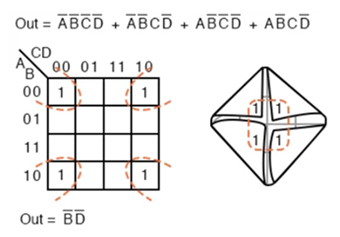
Figure 3. Corner Grouping in a 4-Variable K-Map
When you look at a 4-variable K-map, some cells may appear far apart, but they are actually connected logically. The K-map wraps around at the edges, which means the left side connects to the right side, and the top connects to the bottom.
As result of this, you can group cells across opposite edges of the map. For example, a cell on the far left can still be adjacent to a cell on the far right if they line up correctly in the K-map arrangement.
The same idea applies to the four corner cells. Even though the corners look separated visually, the K-map treats them as neighboring cells. This means all four corners can form one valid group when they contain the required values.
As you solve more K-map problems, you will notice that edge wrapping often helps you create larger and more efficient groups. You might miss these connections if you only focus on the physical layout of the map instead of the logical adjacency behind it.
Don’t-Care Conditions in 4-Variable K-Maps
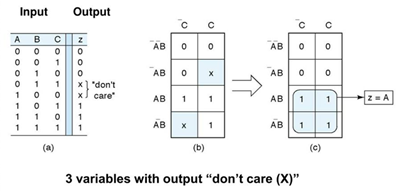
Figure 4. Don’t-Care Condition Simplification Example
In a 4-variable Karnaugh Map, don’t-care conditions are input combinations that your circuit does not use or does not need to respond to. These cells are usually marked as “X,” and you can treat them as either 1 or 0 during simplification.
You can use don’t-care cells when they help create a larger and simpler group. This can reduce the final Boolean expression and make the circuit need fewer logic gates. For example, in a BCD circuit, the binary values from 1010 to 1111 are unused, so they can be treated as don’t-care conditions.
However, you do not need to use every don’t-care cell. If an “X” does not help make the expression simpler, it is better to ignore it. The main purpose is to give you more flexibility, not to force every don’t-care value into a group.
SOP vs POS Simplification Using K-Maps
When using a K-map, you can simplify logic functions using either SOP (Sum of Products) or POS (Product of Sums) form. The main difference is whether you group 1s or 0s inside the map.
|
Feature |
SOP
Simplification |
POS
Simplification |
|
Cells Grouped |
Group 1s |
Group 0s |
|
Full Meaning |
Sum of Products |
Product of Sums |
|
Result Structure |
OR of AND terms |
AND of OR terms |
|
Focus of
Simplification |
True output
conditions |
False output
conditions |
|
Common Logic Form |
AND-OR circuits |
OR-AND circuits |
|
Standard Notation |
Σm (minterms) |
ΠM (maxterms) |
|
K-map Starting Point |
Active outputs |
Inactive outputs |
|
Usually Preferred
When |
More 1s are easier to
combine |
More 0s are easier to
combine |
|
Simplification Goal |
Minimize logic for
HIGH outputs |
Minimize logic for
LOW outputs |
|
Common Use in Design |
Combinational output
logic |
Control and
inactive-state logic |
4-Variable K-Map vs Boolean Algebra
|
Feature |
4-Variable K-Map |
Boolean Algebra |
|
Simplification Method |
Simplifies logic visually by grouping adjacent cells in a map layout |
Simplifies logic mathematically using Boolean laws, identities, and theorems |
|
Best Suited For |
Small and medium combinational logic functions, especially 4-variable problems |
Complex logic expressions, higher-variable systems, and advanced logic analysis |
|
Ease of Learning |
Easier to understand as the simplification process is visual and easier to follow |
Requires deeper understanding of Boolean rules and symbolic manipulation |
|
Speed of Simplification |
Faster for small logic problems because grouping patterns are easy to recognize |
May require many algebraic steps and repeated rule application |
|
Error Detection |
Mistakes are easier to spot visually when cells are grouped incorrectly |
Errors can be harder to trace because calculations are symbolic |
|
Practical Design Use |
Used for teaching, circuit simplification, and quick logic optimization |
Applied in advanced digital design, theorem derivation, and hardware analysis |
|
Scalability |
Becomes difficult and crowded when the number of variables increases |
More practical for large-scale expressions and complex systems |
|
Visualization of Logic |
Clearly shows adjacency, grouping, and simplification patterns |
Does not provide a visual representation of logical relationships |
|
Flexibility |
Limited mainly to map-based simplification |
Can manipulate expressions in many different forms and conditions |
|
Main Advantage |
Quick and intuitive simplification for smaller logic circuits |
Powerful and flexible for advanced mathematical logic operations |
Tips for Solving K-Maps Faster
Start with the largest groups first: Do not group small pairs immediately. Bigger groups usually give you shorter and simpler Boolean terms.
Check the edges and corners early: In 4-variable K-maps, some cells can connect through edge wrapping, so do not only look at cells beside each other in the middle.
Avoid unnecessary small groups: Before adding a small group, check if its cells are already covered by a larger group. This helps prevent extra terms.
Look for repeating patterns: Similar rows or columns can help you see possible groups faster and reduce solving time.
Read unchanged variables carefully: After choosing a group, focus only on the variables that stay the same. Those are the variables that appear in your final term.
Do one final check: Make sure every required 1 is covered and no group was added without improving the answer.
Practical Uses of 4-Variable Karnaugh Maps
Combinational logic design: You can use 4-variable K-maps to simplify circuits with four input signals and one output.
Decoder and multiplexer circuits: They help reduce extra logic in decoder outputs, multiplexer selection logic, and control circuits.
FPGA and microcontroller logic: K-maps help you understand and check simplified logic before or after using design software.
Lower gate count: A simpler expression usually needs fewer logic gates, which makes the circuit easier to build.
Reduced circuit complexity: Fewer gates also mean simpler wiring, less board space, and easier troubleshooting.
Better power efficiency: In some circuits, reducing unnecessary gates can also lower switching activity and power use.
Learning and troubleshooting: K-maps are great if you need to verify, simplify, or debug digital logic designs.
 ABOUT US
Customer satisfaction every time. Mutual trust and common interests.
ABOUT US
Customer satisfaction every time. Mutual trust and common interests.
function test. The highest cost-effective products and the best service is our eternal commitment.
Hot Article
- LM358 Dual Operational Amplifier Comprehensive Guide: Pinouts, Circuit Diagrams, Equivalents, Useful Examples
- Are CR2032 and CR2016 Interchangeable?
- Understanding the Differences ESP32 and ESP32-S3 Technical and Performance Analysis
- Choosing the Right Battery: A Guide to AG4, LR626, LR66, 177/376/377, SR626, and SR626SW Equivalents
- BC547 Transistor Basics: Pinout, Application Circuits, Alternative/Complementary Models
- NPN vs. PNP: What's the Difference?
- esp32 vs stm32: which microcontroller is better for you?
- What Is a MOSFET and How It Works?
- Electrical Relay Basic: Working Operation, Types and Uses
- PNP Transistors: Structure, Working Principle and Application
 HCI in Modern Devices: USB, Bluetooth, xHCI, and Embedded Systems
2026-05-28
 How to Test an ECU and Spot Common Problems
2026-05-27
Frequently Asked Questions [FAQ]
1. Why are 4-variable Karnaugh Maps limited to 16 cells?
A 4-variable K-map represents all possible input combinations of four binary variables. Since each variable has two states, the total combinations become 2⁴ = 16.
2. Can a 4-variable K-map simplify XOR and XNOR logic?
Yes. A 4-variable K-map can simplify XOR and XNOR expressions, although these functions sometimes produce patterns that are less compact than standard AND-OR simplifications.
3. Why do some K-map simplifications still produce multiple terms?
Some logic functions cannot be reduced into a single large group since the required cells are separated. In these cases, multiple simplified terms are still necessary.
4. What happens if a wrong cell is filled in the K-map?
One incorrect cell can change the entire simplified expression and produce an incorrect logic circuit output. Accurate cell placement is needed.
5. Can a single cell belong to multiple groups in a K-map?
Yes. Reusing a cell in different groups is allowed if it helps create larger or more efficient simplifications.
6. How do K-maps help reduce hardware cost?
Simplified Boolean expressions require fewer logic gates and less wiring, which can reduce circuit size, manufacturing cost, and overall hardware complexity.
7. Why do larger groups create simpler logic expressions?
Larger groups remove more changing variables, which results in fewer variables remaining in the final Boolean term.
Hot Part Number
 CL31C180GGFNCNE
 UMK325B7105MH-T
 12101U201JAT2A
 GRM1886S1H5R7DZ01D
 TAP106K016DTW
 TAJC105K050H
 HFBR-4513Z
 SI4850EY-T1-E3
 MAX44271AUA+T
 VI-JN4-EX
- RT0402DRE0730RL
- ACS724LLCTR-30AU-T
- IS42S16800F-7TL
- V48C28T150BL2
- VI-J62-CW
- V300A24H500BL
- DD230S18K
- V48B12C250AL2
- VI-J61-CW/S
- ADUM1301ARW
- SN74AHC08D
- TL074ACDR
- FSFR1800XS
- T491A106K010ZTAU00
- TAJC156K010TNJ
- AD8541ARTZ-REEL
- 1ED020I12-BA
- 9LPRS475CGLF
- CY27H010-45ZC
- DAC34SH84I
- HI-8585PSI
- K9F5608Q0C-HIBO
- LCMX0640C-3T144C
- LM3429MH
- M25P16-VME6TG
- M37450M8-178FP
- MAX3082EESA
- MT48LC32M8A2TG-75
- SFH4556
- SSM6N44FE
- AN27053A-PL
- EL2020CN
- KPC357NT
- MB90F562L
- ST92163/NHB
- AT83C26RKTUL
- XC3S1200E-FTG256C
- MSD388USV-V6
- TD62504FNG